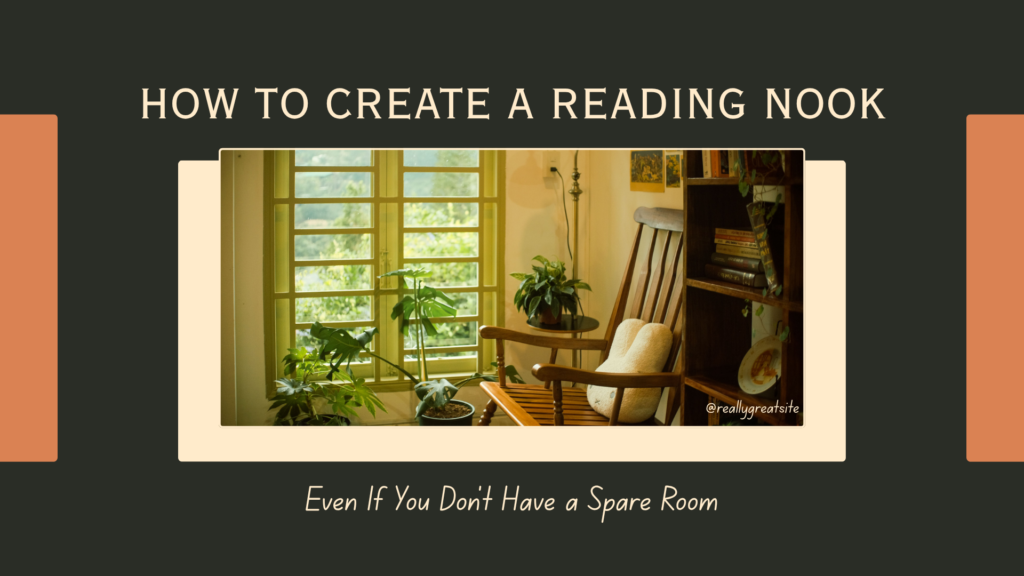
How to Create a Reading Nook, Even If You Don’t Have a Spare Room
Most unused corners stay unused because nothing about them invites you to sit down. A reading nook fixes that with surprisingly little: not a sunroom, not a home library, just one spot set up well enough that you actually choose it over the couch and your phone.
Here’s how to create a reading nook that you’ll actually use, covering where to put it, what to sit in, how to light it, and the small details that turn a chair in a corner into an actual favorite spot in the house.
Start With the Spot, Not the Furniture
The instinct is to shop for a chair first. Don’t. Pick the location first, because it determines everything else. A corner reading nook can work in as little as 3 by 3 feet, so this isn’t about finding a spare room, it’s about finding an underused corner: the end of a bedroom, the dead space beside a bookshelf, even a closet with the doors removed.
Natural light matters more than square footage. A spot near a window means you’ll actually use it during the day without extra lighting, and if you can’t move a chair to a window, a tall, narrow bookshelf placed in front of one can define the space while still letting light through. Quiet matters too. A nook in a high-traffic hallway gets used a lot less than one tucked slightly out of the main path.
Pick a Chair That Actually Fits the Space
This is where most reading nooks fail before they start: an oversized chair dropped into a small corner that instantly makes the whole space feel cramped instead of cozy. Measure the actual footprint you have before you shop, not just the chair’s seat width but its full frame, since papasan and barrel chairs both take up more floor space at the base than they look like they will in photos.
As a general rule, seating that sits at or below standard chair height (around 17 to 18 inches) reads as less bulky in a small space and keeps the room feeling more open. If you want real options broken down by size and budget, we’ve already done that legwork: check out our picks for the best chairs for a reading nook, from a $59 slipper chair to an oversized chaise for stretching out.
Get the Lighting Right
Bad lighting is the single most common reason a reading nook goes unused after the first week. Overhead light alone is almost never enough, and it casts the wrong kind of shadow for reading anyway. You want dedicated task lighting: a floor or table lamp positioned so the light lands on the page, not in your eyes.
Aim for a bulb in the 400 to 800 lumen range for comfortable reading light in a small space, and look for a warm color temperature between 2700K and 3000K. Anything above 4000K reads as cool and clinical, more office than cozy corner, and warmer light does less to interfere with winding down in the evening. A dimmable option gives you flexibility between an afternoon reading session and a low-light evening one, and a flicker-free LED matters more than people expect: flicker you don’t consciously notice is a common hidden cause of eye fatigue during long reading sessions.
Layer In the Coziness
Once the chair and lighting are sorted, the coziness of a reading nook comes down to texture, not size. A soft throw blanket, a couple of pillows in a texture you actually want to touch (wool, cotton knit, sherpa), and if the floor is hard, a small rug underfoot to keep the whole corner from feeling sterile.
This is also where restraint matters. One good throw and one or two pillows read as intentional. Five decorative pillows you have to move every time you sit down read as clutter, and clutter is the fastest way to make a small nook feel smaller instead of cozier.
Keep Everything You Need Within Arm's Reach
A reading nook without somewhere to set down a drink, your glasses, or your phone isn’t finished. It doesn’t need to be a full side table if the space can’t fit one. A small wall-mounted shelf, a stool repurposed as a mini table, or even a shallow basket on the floor beside the chair all solve the same problem: keeping your book, water, and reading light within reach so you’re not getting up every ten minutes.
Vertical space is your friend in a tight nook. A narrow wall shelf for a small stack of books keeps your current reads close without eating into the floor space a side table would need.
Add One Personal Touch, Then Stop
The difference between a chair in a corner and an actual reading nook is usually one specific, personal detail: a plant, a small piece of art you love, a candle, a mug shelf. Pick one. The temptation is to decorate the whole corner, but a reading nook is a small space, and one intentional detail reads as a jewel box. Five competing ones just read as busy.
The Bottom Line on How to Create a Reading Nook
You don’t need a renovation or a dedicated room. You need one well-chosen corner, a chair sized to actually fit it, light that’s warm and bright enough to read by without straining your eyes, a couple of soft textures, and somewhere to set your water down. Get those five things right and the hardest part becomes done: you’ll have a spot in your home that’s genuinely more appealing than the couch and your phone.
Ready to actually buy the chair? Check out our picks for the best chairs for a reading nook, sorted by budget and space.
- Cozy Home
- Gadgets for Her
- Jewelry & Accessories
- Skincare & Outfits
- Wellness Reads & Gifts
Winter Capsule Wardrobe Salome September 6, 2026 A real winter capsule wardrobe isn’t 11 pieces, and it isn’t monochrome either....
Fall Capsule Wardrobe: 16 Real Pieces From 4 Retailers, Styled Into 5 Outfits (2026) Salome September 5, 2026 Most fall...
How to Create a Reading Nook, Even If You Don’t Have a Spare Room Salome September 4, 2026 Most unused...